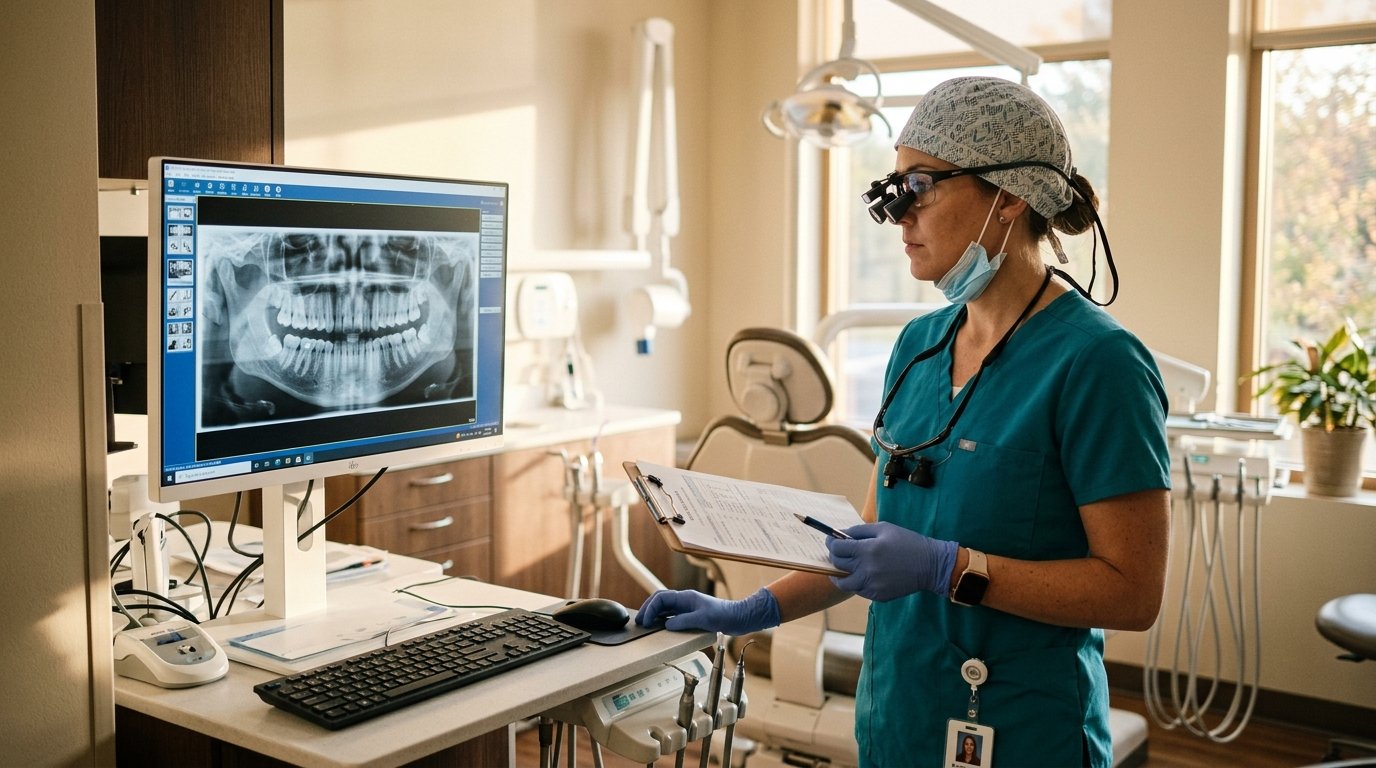
Late in a clinical day, deciding starts to feel like more work than doing. Most dentists describe the same drift: you take the option that needs the least deliberation, you push the treatment conversation to the next visit, and you accept a plan that is adequate rather than comparing it with a better one.
The dentistry usually stays technically fine. The thinking around it gets narrower, and you can feel it happening if you look for it.
What does the drift look like at the chair?
Once it is named, most people recognize their own version. Watch for a week and see whether any of these describe you.
- Treatment conversations get shorter after lunch than before it.
- Borderline calls get deferred rather than made.
- You are more inclined to watch a questionable tooth late in the day than early.
- Case presentation gets thinner, and acceptance follows it down.
- Small administrative questions start feeling out of proportion to their size.
None of that is negligence, and none of it means anything is wrong with you. It is what a long day of deciding feels like from the inside.
Why does this job produce so much of it?
Volume and variety. A full day is an unbroken sequence of small judgments about margins, shade, occlusion, when to stop, when to refer, and how to word a finding for someone who is already anxious.
Then the business arrives on top of it, unscheduled. Moving from a clinical call to a staffing call and back again is the part that feels expensive, and owners get the worst of it because the business questions do not wait for a gap.
How do you build a schedule around it?
You cannot get rid of the decisions. You can move the important ones earlier and stop making the pointless ones.
Put high-stakes judgment in the morning. Comprehensive exams, complex planning, and hard case conversations early. Protocol-driven work later. If you have any say over your template, this is the cheapest thing to test.
Cut the total count. Every recurring decision you convert into a standing protocol is one you stop making from scratch. Material defaults, recall intervals, referral criteria, what the team does with a same-day cancellation. Protocols are not rigidity. They are a way of spending your judgment on the cases that need it.
Defend the gaps. A template with no slack means every non-clinical question interrupts clinical work. Even short buffers give those questions somewhere to land.
Stop deciding trivia. Lunch, scrub color, the order of the huddle. This is not a productivity trick. It is simply fewer times a day that you have to weigh anything.
What about the end of the day?
Be suspicious of consequential choices made when you are done. Financial commitments, hiring, difficult emails, and replies to complaints all read differently in the morning.
A rule worth adopting: anything with a signature or a lasting consequence waits overnight. Almost nothing in a dental practice is urgent enough to beat that rule, and the few things that are will be obvious.
What is worth telling your team?
Say it plainly, because they will otherwise interpret your late-day terseness as displeasure with them. Tell them which decisions you want early, what they can decide without you, and what genuinely has to interrupt you.
Teams are usually relieved by this. Most interruptions exist because nobody ever told them what the alternative was.
When is this not about the schedule?
If your afternoons have gotten harder and your mornings are starting to feel that way too, or if the flatness is no longer lifting on weekends, a scheduling change is unlikely to be the answer. That is a reasonable thing to bring to a physician or therapist, and your state association’s wellbeing program is another confidential place to start.
Working longer to compensate is the one option that reliably makes the next week harder.
FAQ
Is this just being tired?
Not quite the same thing. Physical tiredness shows up in your stamina. What most dentists notice late in the day is about judgment: more deferring, more defaulting, less appetite for a longer conversation. You can feel physically fine and still be deciding differently than you were in the morning.
Does front-loading complex cases actually work?
It costs nothing to test, which is the best argument for it. Put comprehensive exams and complex planning early, leave protocol-driven procedures for later, and give it a month before you judge. If your case conversations feel clearer, keep it. If nothing changes, you have lost nothing.
How do protocols help?
Every decision you have already made well once and written down is a decision you stop re-making daily. Material defaults, referral criteria, and cancellation handling are the obvious candidates. What you get back is attention, and you can spend it on the cases that genuinely need your judgment.